Vedic Seminar in Memphis
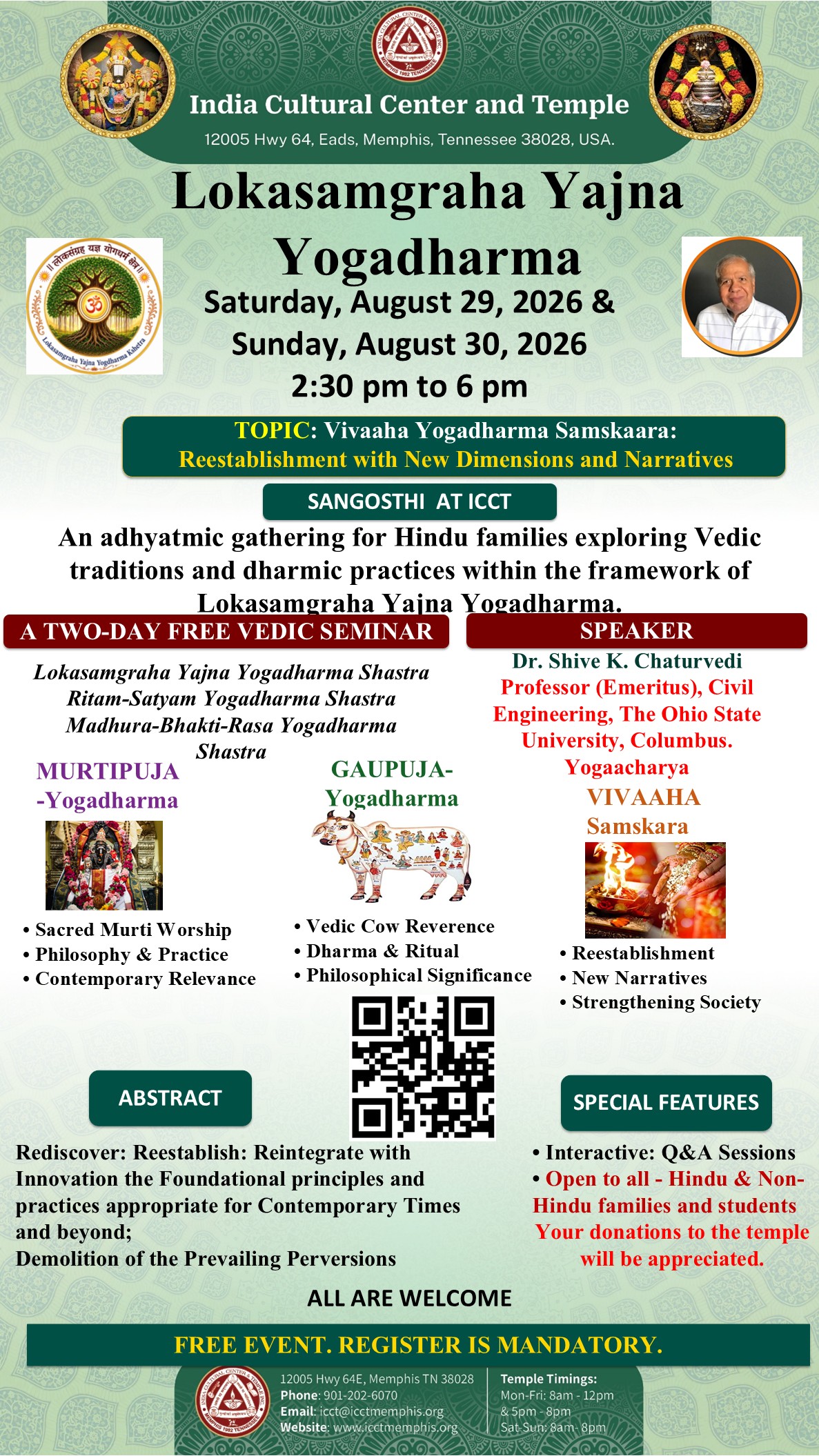
A two-day Vedic Seminar was held at the India Cultural Center and Temple (ICCT), Memphis, on August 29–30, 2026, featuring detailed discussions on Vivaaha Samskaara, Gaupuja-Yogadharma, and Murtipuja-Yogadharma.
The seminar was led by Dr. Shive K. Chaturvedi, Yogadharmaacharya and Professor Emeritus of Civil Engineering at The Ohio State University. The sessions explored the philosophical foundations, traditional practices, contemporary relevance, and the need for renewed understanding of these important dimensions of Sanatana Dharma.
Event Details
- Event: Two-Day Free Vedic Seminar
- Dates: Saturday, August 29 and Sunday, August 30, 2026
- Time: 2:30 PM – 6:00 PM
- Venue: India Cultural Center and Temple (ICCT), Memphis, Tennessee
- Speaker: Dr. Shive K. Chaturvedi
- Main Subjects: Vivaaha Samskaara, Gaupuja-Yogadharma, and Murtipuja-Yogadharma
Vivaaha Samskaara: Reestablishment with New Dimensions and Narratives
The session on Vivaaha Samskaara examined Vivaaha not merely as a social marriage or wedding but as a Samskaara and a Yogic process connected with the responsibilities of Grihastha Ashrama.
The discussion placed Vivaaha within the wider framework of the Shodasha Samskaras. It explored its development through the Grihya Sutras, Shrauta Sutras, Dharma Sutras, Smritis, Puranas, Mahabharata, Ramayana and other traditions.
The seminar presented Vivaaha Samskaara-Yoga as the Yogic union of man and woman for entering Grihastha Ashrama. It also explored how the household can become a Yogadharma-Kshetra where responsibilities toward family, society and the wider world are consciously upheld.
Particular attention was given to the seven commitments of Vivaaha Samskaara. These include the pursuit of a pure and healthy household, mutual strength, righteous wealth, knowledge and harmony, the nurturing of virtuous children, longevity and lifelong companionship.
The session also introduced the idea of integrating the Seven Great Yajnas into the life of Grihastha. These are Parivaara, Bhuta, Manushya, Pitra, Deva, Brahma and Rashtra.
The discussion called for a renewed understanding of traditional Samskaaras through Continuity-with-Innovation while retaining their foundational Dharmic principles.
Gaupuja-Yogadharma: Vedic Cow Reverence, Dharma and Philosophical Significance
The session on Gaupuja-Yogadharma explored the place of Gau within the Vedic understanding of the sacred and interconnected natural world.
The discussion emphasized that the Vedic worldview recognizes the interdependence of human beings, nature and the wider cosmos.
The presentation examined the many dimensions associated with Gau. These include nourishment, vitality, fertility, motherhood and wisdom.
Various traditional names such as Aghnya, Ushra, Ushriya, Dhenu and Gau were also discussed in relation to the Vedic understanding of the Cow.
Gaupuja was presented not simply as a ritual but as an expression of reverence, Ahimsa and responsible relationship with the natural world.
The discussion connected Gau with the broader framework of Dharma, Artha, Kama and Moksha. It also considered its practical, philosophical and spiritual significance.
The session addressed the contemporary relevance of Gaupuja-Yogadharma. It proposed measures such as Gau-Murti with Prana-Pratishtha, annual Go-Puja on Gopashtami and educational programs for contemporary and future generations.
Murtipuja-Yogadharma: Sacred Murti Worship, Philosophy and Practice
The session on Murtipuja-Yogadharma examined the meaning, purpose and practice of Murti Puja within the Yogadharmic framework.
The discussion addressed the nature of the Murti and the purpose of its worship. It also explored the relationship between the devotee and the Deity and the manner in which Puja is structured.
The presentation explained that Murtis may be prepared from different materials including stone, metal, wood, clay, sandalwood paste, sand, ink or paint and gems. The discussion also referred to Manomayi Murti and the role of the devotee’s Sattvic Shraddha in the process of worship.
Murtipuja was presented as a process of Yogic integration and inner transformation. Through sacred space, invocation, purification, chants, prayers, Bhajans, Arati, blessings and Prasadam the devotee participates in a structured spiritual practice that develops concentration, consciousness, surrender and a deeper relationship with the Deity.
The session further explored the relationship between Karmakanda, Jnanakanda and Upasana Kanda. Their harmonious integration was presented as part of Samagra Yoga.
The contemporary relevance of Murtipuja-Yogadharma was also considered in relation to personal, family, social and wider dimensions of life.
A Unified Yogadharmic Vision
The three sessions presented different dimensions of Vedic Yogadharma while remaining connected through a common vision of Dharma and responsible living.
Vivaaha Samskaara focused on the transformation of family life into a field of Dharma. Gaupuja-Yogadharma explored reverence for Gau and the natural world. Murtipuja-Yogadharma examined the role of worship in spiritual practice and inner transformation.
Together these discussions presented Sanatana Dharma as a living tradition with relevance for individual life as well as family and society.
About the Speaker
Dr. Shive K. Chaturvedi is a Yogadharmaacharya and Professor Emeritus of Civil Engineering at The Ohio State University in Columbus.
He is associated with Lokasamgraha Yajna Yogadharma Shastra, Ritam-Satyam Yogadharma Shastra and Madhura-Bhakti-Rasa Yogadharma Shastra.
Watch the Seminar
Presentation Materials
The following presentation materials were used during the seminar. They provide the detailed study material for the three sessions.
Vivaaha Samskaara
Gaupuja-Yogadharma
Murtipuja-Yogadharma
Continuing the Yogadharmic Journey
The two-day seminar provided an opportunity to revisit important aspects of Sanatana Dharma and to explore their meaning through the framework of Yogadharma.
The discussions on Vivaaha Samskaara, Gaupuja-Yogadharma and Murtipuja-Yogadharma highlighted the relationship between traditional practices and the responsibilities of contemporary life.
The seminar encouraged a deeper understanding of these traditions and their continued relevance for individuals, families and society.
Leave a Reply